Should you pay extra on your mortgage or invest the difference? It’s the most argued-over question in personal finance, and a pay extra mortgage or invest calculator answers it better than any rule of thumb — because the right choice depends on your rate, your timeline, and your stomach for risk. Run your own numbers in NovaFluxT’s free mortgage calculator as you read, then use the worked example below to see how the math actually compares.
Extra principal payments give you a guaranteed, after-tax return equal to your mortgage rate: every dollar of principal you kill early stops compounding interest at that rate, forever. Investing offers higher expected returns with real risk — the market doesn’t promise 7%, and gains get taxed. Neither choice is wrong in the abstract; the math below shows how to pick for your situation. The deciding factors are your interest rate, your time horizon, and how you feel about locking money into home equity versus keeping it liquid. See the CFPB’s guide to paying down a mortgage. See the CFPB’s guide to prepayment penalties. See the Federal Reserve’s guide to refinancings.
The two options, side by side
Option A — Prepay the mortgage. Add a fixed amount to principal each month. Your required payment doesn’t change, but the loan dies years early and total interest collapses. The “return” is certain and tax-free (you’re avoiding interest, not earning income), but the money becomes illiquid home equity.
Option B — Invest the difference. Put that same monthly amount into an index fund or retirement account. Expected long-run returns beat most mortgage rates, but “expected” is doing heavy lifting — and in a taxable account, gains face capital-gains tax.
Worked example: $400,000 mortgage at 7% vs investing $300/month
The loan: $400,000, 7% APR, 30 years.
- Monthly principal & interest: $2,661.21
- Lifetime interest if paid on schedule: $558,035.59
Option A — pay an extra $300/month toward principal:
- New effective payment: $2,961.21
- Payoff time: 266.7 months (22.2 years) instead of 360
- Total interest paid: $389,642.47
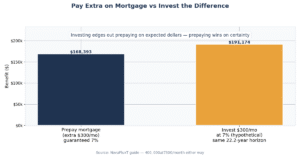
- Interest saved: $168,393.13 — and you’re debt-free 7.8 years early
That’s a guaranteed 7% after-tax return on every extra dollar, with zero market risk.
Option B — invest $300/month at a 7% average annual return:
- After 30 years: $365,991.30 ($108,000 contributed, $257,991.30 in growth)
- Over the same 22.2-year horizon as the payoff: $191,173.82
So investing edges out prepaying on raw dollars ($191,174 vs $168,393 saved) — if you actually earn 7%, after taxes on gains, and if you stay invested through every downturn for 22 years. The prepayment wins on certainty; investing wins on expected value. Your risk tolerance breaks the tie.
One thing beats both: if your employer offers a 401(k) match, contribute enough to capture the full match first — that’s an instant 50–100% return no mortgage or market can touch. See our Roth vs Traditional 401(k) guide to pick the right account.
Frequently asked questions
Is it better to pay extra on my mortgage or invest?
It depends on your mortgage rate versus your expected after-tax investment return and your risk tolerance. As a rough framework: if your rate is above ~6–7%, prepaying’s guaranteed return is hard to beat; below ~4%, investing usually wins over long horizons. Always capture any employer 401(k) match before either.
What rate of return do I get from extra mortgage payments?
Exactly your mortgage interest rate, guaranteed and after-tax. On a 7% mortgage, each extra principal dollar “earns” 7% by killing future interest — the equivalent of a risk-free 7% bond. No investment offers that combination of certainty and yield, which is why prepaying high-rate debt is so powerful.
Does paying extra affect my mortgage interest tax deduction?
Yes, slightly. Less interest paid means a smaller deduction if you itemize — but most filers take the standard deduction anyway ($16,100 single / $32,200 joint in 2026), in which case there’s no deduction to lose. Don’t let the tax tail wag the dog: a deduction only returns a fraction of each interest dollar.
Should I invest instead if my mortgage rate is low?
Probably. At 3–4%, the guaranteed return from prepaying is modest, and diversified investing has historically beaten it over 15+ year horizons. The exception is psychological: if being debt-free lets you sleep at night, that peace of mind has real value no spreadsheet captures.
Where can I run my own pay-extra-vs-invest numbers?
Use NovaFluxT’s free mortgage calculator to model extra payments on your loan — enter your balance, rate, and extra amount to see your new payoff date and interest saved in seconds. Then pair it with the compound interest calculator to project what investing the difference could grow into. No sign-up needed.
Related tools and guides
- Mortgage Calculator — model extra payments on your loan
- Compound Interest Calculator — project the invest-the-difference side
- Biweekly vs Monthly Mortgage Payments — another way to kill mortgage interest early
- How Much House Can You Afford on an $80,000 Salary? — payment math before you buy