Roth vs Traditional 401(k) — which wins for you? Here is the answer most articles bury: if your tax rate is the same now and in retirement, it’s an exact tie. We ran $10,000 a year for 30 years at 7% growth through both accounts, and each leaves you with $736,794 of spendable money. The real question is never “which account is better” — it’s “will my tax rate be higher or lower when I retire?”
Test your own numbers with NovaFluxT’s free 401(k) calculator — adjust contributions, employer match, and expected return to project your nest egg instantly. See the IRS 2026 401(k) contribution limits. See the SEC’s compound interest calculator.
The one-sentence answer
Same tax rate now and later → tie. Lower rate in retirement → Traditional wins. Higher rate in retirement → Roth wins. Everything below proves it with real numbers.
Worked example: $10,000 a year for 30 years
Assumptions (labeled): age 30, $90,000 salary, contributes the pre-tax equivalent of $10,000/yr for 30 years, 7% average annual growth, current marginal tax bracket 22%, no employer match in this comparison (we cover the match separately below — it always goes in pre-tax).
The growth math uses the future value of an annuity:
FV = C × ((1 + r)^t − 1) / r
With r = 0.07 and t = 30: (1.07)^30 = 7.612255, so the annuity factor is (7.612255 − 1) / 0.07 = 94.4608. Every dollar contributed annually becomes $94.46 after 30 years.
Traditional 401(k): the full $10,000 goes in pre-tax each year.
FV = $10,000 × 94.4608 = $944,608 (pre-tax). You pay tax when you withdraw. At a 22% retirement bracket: $944,608 × (1 − 0.22) = $944,608 × 0.78 = $736,794 spendable.
Roth 401(k): you pay the 22% tax first, so $10,000 of earnings becomes $10,000 × 0.78 = $7,800 of contribution each year.
FV = $7,800 × 94.4608 = $736,794 — and every dollar comes out tax-free.
| Traditional 401(k) | Roth 401(k) | |
|---|---|---|
| Annual contribution | $10,000 pre-tax | $7,800 after-tax |
| Balance at 65 | $944,608 | $736,794 |
| Tax at withdrawal (22%) | −$207,814 | $0 |
| Spendable money | $736,794 | $736,794 |
Identical — to the dollar. That’s not a coincidence; it’s arithmetic.
Why it’s a tie (in plain English)
Paying 22% on the seed versus 22% on the harvest gives the same result, because multiplication doesn’t care about order: ($10,000 × 0.78) × growth is exactly the same as ($10,000 × growth) × 0.78. The account type only matters when the two tax rates differ — which, for most people, they do.
When the tie breaks: the only table that matters
Keep everything else identical and vary only the retirement-year tax bracket:
| Retirement bracket | Traditional spendable | Roth spendable | Winner |
|---|---|---|---|
| 12% (lower in retirement) | $944,608 × 0.88 = $831,255 | $736,794 | Traditional by $94,461 |
| 22% (same as today) | $736,794 | $736,794 | Tie |
| 32% (higher in retirement) | $944,608 × 0.68 = $642,333 | $736,794 | Roth by $94,461 |
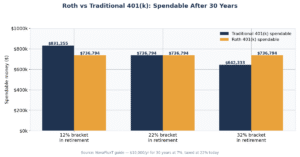
Most workers land in a lower bracket after retiring (no salary, smaller income), which is why the textbook advice favors Traditional for peak earners — and why Roth is so powerful for young or lower-income savers whose bracket can only go up.
The 5-question decision framework
- Will your retirement tax rate be lower than today’s? If yes — the common case for high earners — lean Traditional. If you’re early-career in the 12% bracket, lean Roth.
- Are you capturing the full employer match? Do this before anything else. Note: matching dollars go into a pre-tax account in most plans, even when your own contributions are Roth — the match doesn’t change the Roth-vs-Traditional math, it just adds free money on top.
- Do you want tax diversification? Splitting contributions hedges against unknowable future tax law — some of each is a legitimate strategy, not indecision.
- Might you retire early? Roth contributions (not earnings) can be withdrawn anytime without tax or penalty, which makes Roth contributions a flexible bridge fund for early retirees.
- Do RMDs or estate plans matter to you? Traditional 401(k)s force required minimum distributions in your 70s; Roth accounts give the original owner a pass on RMDs, which matters for legacy planning.
One more consideration that cuts across all five: a dollar of house payment is a dollar not compounding in either account. If you’re balancing homeownership against retirement saving, see our breakdown of how much house an $80,000 salary affords to size the other side of that trade-off.
Frequently asked questions
Can I contribute to both Roth and Traditional 401(k) accounts?
Yes. The IRS sets one combined annual limit for all your 401(k) contributions, and you may split it between Roth and Traditional in any proportion your plan allows. Many savers put enough in Traditional to drop into a lower bracket, then direct the rest to Roth — a clean way to diversify against future tax changes.
Does my employer’s match go into my Roth account?
In most plans, no — matching dollars land in a pre-tax (Traditional) account even when your own contributions are Roth. You still get the full match; it simply grows tax-deferred and is taxed on withdrawal. Check your plan documents, because a minority of plans now offer a Roth match election.
I’m young and in the 12% bracket — which should I pick?
Roth, in most cases. At 12%, you’re paying the lowest plausible price for tax-free growth, and your bracket is far more likely to rise than fall over a career. The worked example above shows the flip side: every bracket-point your retirement rate lands below today’s rate is money Traditional keeps.
Should I switch from Traditional to Roth after a big raise?
Revisit the decision, yes. A raise that lifts your marginal rate from 22% to 32% changes the math meaningfully in Traditional’s favor going forward. You don’t need to move old money — just redirect new contributions. Many plans let you split each paycheck’s contribution between the two.
Is the tie really exact in real life?
Mathematically yes at equal tax rates, before fees and real-world wrinkles. In practice, small differences creep in: RMDs can push Traditional withdrawals into higher brackets, Roth’s lack of RMDs aids estate planning, and contribution limits are nominal (a maxed-out Roth contribution shelters more real wealth than the same nominal Traditional one). The tie is the right baseline; the wrinkles decide close calls.