The biweekly vs monthly mortgage payments debate has a clear mathematical winner: paying half your mortgage every two weeks instead of the full amount monthly shaves years off your loan and tens of thousands off your interest bill. The reason is simple — 26 half-payments a year equals 13 full monthly payments, so you make one extra payment annually without feeling it. Run your own loan through NovaFluxT’s free mortgage calculator first, then follow the worked example below to see exactly where the savings come from. See the CFPB’s guide to paying down a mortgage. See the Federal Reserve’s guide to refinancings. pay extra on your mortgage or invest
How biweekly payments work
A monthly schedule means 12 payments a year. A biweekly schedule means a payment every 14 days — 26 payments a year. Since each biweekly payment is half the monthly amount, you pay 26 × ½ = 13 monthly equivalents per year. That 13th payment goes straight against principal, which is what accelerates everything.
Worked example: $400,000 loan, 30 years, 7% APR
Step 1 — the standard monthly payment
The amortization formula:
M = P × r × (1 + r)^n / ((1 + r)^n − 1)
where P = $400,000, r = 0.07/12 = 0.0058333, n = 360 payments.
- (1.0058333)^360 ≈ 8.1165
- M = 400,000 × 0.0058333 × 8.1165 / 7.1165 = $2,661.21/month
- Total paid over 30 years: $2,661.21 × 360 = $958,035.59
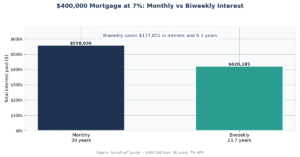
- Total interest: $958,035.59 − $400,000 = $558,035.59
Step 2 — switch to biweekly
- Biweekly payment: $2,661.21 ÷ 2 = $1,330.61 every two weeks
- Paid per year: $1,330.61 × 26 = $34,595.73 vs. $2,661.21 × 12 = $31,934.52 monthly — an extra $2,661.21 (exactly one monthly payment) applied to principal each year
- Biweekly rate: 0.07 ÷ 26 ≈ 0.0026923 per period
- Periods to payoff: n = −ln(1 − 400,000 × 0.0026923 / 1,330.61) / ln(1.0026923) ≈ 616.4 payments
- 616.4 ÷ 26 = 23.7 years to payoff
Step 3 — the savings
- Total paid biweekly: 616.4 × $1,330.61 ≈ $820,184.60
- Total interest biweekly: $820,184.60 − $400,000 = $420,184.60
- Interest saved: $558,035.59 − $420,184.60 = $137,851
- Time saved: 30 − 23.7 = 6.3 years
Same loan, same rate — the only change is payment timing, and it erases over $137,000 in interest.
Three caveats before you switch
- The extra must hit principal. Confirm with your servicer that biweekly payments are credited every two weeks and the surplus reduces principal — some lenders hold partial payments in suspense until a full payment accumulates, which kills the benefit.
- Watch for fees. Some servicers charge a setup or per-payment fee for biweekly plans. A fee over ~$300/year meaningfully eats the savings; in that case, DIY it (caveat 3).
- You can DIY without a biweekly plan. Add one-twelfth of your payment ($221.77 here) to each monthly payment, or make one lump extra payment a year — the math is identical. The biweekly schedule just automates the discipline.
One tax note: less interest paid means a smaller mortgage-interest deduction if you itemize. That rarely outweighs $137,851 in savings, but it’s worth knowing — our 2026 federal tax brackets guide explains how deductions interact with your bracket.
Frequently asked questions
Does paying biweekly really save money, or is it a gimmick?
It’s real math, not a gimmick — but the savings come from the extra annual payment, not the “biweekly” label itself. Any schedule that puts 13 monthly payments toward the loan each year produces the same result.
Can I get the same result by just paying extra each month?
Yes. Adding $221.77 (one-twelfth of $2,661.21) to every monthly payment replicates the biweekly outcome exactly: payoff in ~23.7 years with ~$137,851 less interest.
Do all lenders offer biweekly payment plans?
No. Many servicers do, some charge fees, and some don’t support it at all. The DIY extra-payment approach works with any lender that allows prepayment without penalty — check your loan terms first.
Will biweekly payments lower my interest rate?
No. The rate stays 7%. You pay less interest because principal shrinks faster, so there’s less balance for the rate to act on — that’s the entire mechanism.
What if my loan amount or rate is different?
The percentage effect scales: biweekly always adds ~8.3% more principal per year (13/12), which typically cuts a 30-year loan to 23–24 years regardless of size. Plug your exact numbers into NovaFluxT’s free mortgage calculator to see your own payoff date and interest saved.