Everyone says avalanche saves more money and snowball feels better — but how big is the actual difference when you run a snowball vs avalanche calculator example on real debts? We simulated both payoff strategies month by month on four real-world debts totaling $22,000, with an $800 monthly budget. The winner saved $1,371.69 in interest and finished one month sooner — but the payoff order reveals something most comparisons miss.
Run your own debts through NovaFluxT’s free debt snowball vs avalanche calculator to see your personal numbers instantly — no sign-up needed. If you’re still choosing a strategy, our snowball vs avalanche deep dive explains which method fits which personality. See the FTC’s guide to getting out of debt. See the CFPB’s guide if you can’t pay your bills.
The four debts we tested
We built a realistic debt profile — the kind of mix millions of households carry:
| Debt | Balance | APR |
|---|---|---|
| Store credit card | $3,200 | 24.99% |
| Rewards credit card | $7,800 | 18.99% |
| Personal loan | $6,500 | 11.99% |
| Medical bill (payment plan) | $4,500 | 0% |
| Total | $22,000 | — |
Assumptions (labeled): $800/month total debt budget; each debt’s minimum payment is 2% of its balance ($25 floor); freed-up minimums roll into the target debt as balances clear. These are standard, middle-of-the-road assumptions — your minimums may differ, which is exactly why running your own numbers matters.
Worked example: the month-by-month results
Snowball (smallest balance first): Store card → Medical bill → Personal loan → Rewards card.
| Payoff order | Debt cleared | Month cleared |
|---|---|---|
| 1st | Store card ($3,200 @ 24.99%) | Month 9 |
| 2nd | Medical bill ($4,500 @ 0%) | Month 17 |
| 3rd | Personal loan ($6,500 @ 11.99%) | Month 26 |
| 4th | Rewards card ($7,800 @ 18.99%) | Month 36 |
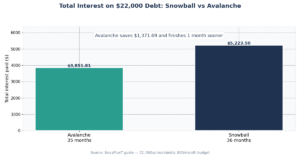
Result: 36 months, $5,223.50 total interest.
Avalanche (highest rate first): Store card → Rewards card → Personal loan → Medical bill.
| Payoff order | Debt cleared | Month cleared |
|---|---|---|
| 1st | Store card ($3,200 @ 24.99%) | Month 9 |
| 2nd | Rewards card ($7,800 @ 18.99%) | Month 23 |
| 3rd | Personal loan ($6,500 @ 11.99%) | Month 31 |
| 4th | Medical bill ($4,500 @ 0%) | Month 35 |
Result: 35 months, $3,851.81 total interest.
The exact difference: avalanche costs $1,371.69 less in interest and finishes one month earlier.
What the numbers actually mean
Three honest takeaways. First, avalanche wins on money — $1,372 is real cash, roughly two extra monthly payments you keep. Second, the time gap is small here (one month), because the highest-rate debt was also the smallest balance, so both strategies attacked it first and got the same quick win in month 9. In profiles where the highest-rate debt is the largest balance, avalanche’s advantage grows.
Third — and this is the nuance most articles skip — snowball’s psychological edge was muted in this test: it cleared the medical bill in month 17 (a nice mid-journey win), but then faced the two biggest balances back-to-back with no more quick victories. If you know you’ll quit without early wins, snowball still has value. If you can stay disciplined, avalanche is mathematically superior, full stop.
How to run your own numbers
- Open the debt snowball vs avalanche calculator.
- Enter each debt: balance, interest rate, and minimum payment.
- Enter your total monthly debt budget.
- Read both simulations side by side: payoff order, debt-free date, and total interest for each method.
Frequently asked questions
Is the avalanche method always better than snowball?
Mathematically, yes — paying the highest interest rate first always minimizes total interest, because every dollar of extra payment kills the most expensive debt first. In our $22,000 example, avalanche saved $1,371.69. The only argument for snowball is behavioral: if quick wins are the difference between sticking with the plan and quitting, the “worse” method you finish beats the “better” method you abandon.
How much does avalanche typically save over snowball?
It depends on the rate spread between your debts. With similar rates across debts, the gap is small (a few hundred dollars). With a wide spread — like a 25% card next to a 0% medical bill, as in our example — the gap reached $1,371.69 on $22,000 of debt. The bigger the rate difference and the larger the balances, the more avalanche saves.
Does the debt-free date differ much between the two methods?
Usually not by much. In our test the difference was a single month (35 vs 36). Avalanche’s advantage shows up mostly in interest paid, not time — because both methods throw the same total monthly budget at the debts. If finishing sooner matters most to you, the lever that moves the date is a bigger monthly payment, not the strategy choice.
What if my highest-rate debt is also my smallest?
Then you get the best of both worlds, like our example: both strategies attack it first, so you get snowball’s quick win and avalanche’s math-optimal start. After it’s gone, the strategies diverge — that’s where you decide between the next-smallest balance (snowball) and the next-highest rate (avalanche).
Should minimum payments be included in the comparison?
Yes — any honest simulation pays every minimum first, then aims the leftover budget at the target debt. Ignoring minimums understates both timelines. Our example used 2%-of-balance minimums ($25 floor), a standard assumption; plug in your actual minimums in the calculator for your exact dates.
Related tools
Pair with: Debt Snowball vs Avalanche: Which Saves More? and How Long to Pay Off $10,000 in Credit Card Debt.