If you’re asking debt snowball vs avalanche — which saves more — the math gives a clear answer: the avalanche method always costs less in total interest, because it kills the most expensive debt first. The real question is how much less, and whether the snowball’s motivational edge is worth the extra cost. To answer that, we ran both strategies month-by-month on the same realistic $15,000 debt load. Try it with your own debts on NovaFluxT’s free debt snowball vs avalanche calculator — enter your balances and APRs to see your debt-free date under each method.
The two methods differ in exactly one decision: which debt gets your extra payment each month. The avalanche targets the highest interest rate first. The snowball targets the smallest balance first. Everything else — paying minimums on all debts, rolling freed-up payments into the next target — is identical. See the FTC’s guide to getting out of debt. See the CFPB’s guide if you can’t pay your bills.
Worked example: $15,000 across three debts
Here’s the scenario, built to look like a typical household juggling cards and a loan:
| Debt | Balance | APR |
|---|---|---|
| Credit card | $5,200 | 26.99% |
| Personal loan | $6,800 | 9.99% |
| Store card | $3,000 | 19.99% |
| Total | $15,000 | — |
Assumptions (same for both strategies): minimum payment = 2% of each balance ($25 floor); $400 extra per month toward the target debt, so the total monthly debt budget is $700; interest accrues monthly at APR ÷ 12; no new spending, no fees.
Month 1, step by step. Interest charged: $5,200 × 26.99% ÷ 12 = $116.96 on the credit card; $6,800 × 9.99% ÷ 12 = $56.61 on the loan; $3,000 × 19.99% ÷ 12 = $49.98 on the store card. Minimums due: $106.34 + $137.13 + $61.00 = $304.47, leaving $395.53 of extra payment for that month’s target.
Avalanche: highest rate first
Payoff order: credit card (26.99%) → store card (19.99%) → personal loan (9.99%).
- Month 12: credit card paid off. Its $106 minimum rolls into the attack on the store card.
- Month 17: store card paid off.
- Month 26: personal loan paid off — debt-free.
- Total interest paid: $2,587. Total paid: $17,587.
Snowball: smallest balance first
Payoff order: store card ($3,000) → credit card ($5,200) → personal loan ($6,800).
- Month 7: store card paid off — the quick win snowball fans talk about.
- Month 18: credit card paid off.
- Month 26: personal loan paid off — debt-free.
- Total interest paid: $2,819. Total paid: $17,819.
The verdict
| Avalanche | Snowball | |
|---|---|---|
| Payoff order | Card → Store → Loan | Store → Card → Loan |
| Months to debt-free | 26 (2 yr 2 mo) | 26 (2 yr 2 mo) |
| Total interest | $2,587 | $2,819 |
| Avalanche saves | $233 | — |
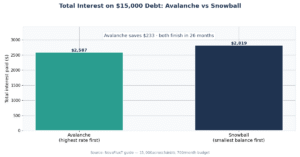
(All figures rounded to the nearest dollar from a full month-by-month amortization.)
Two honest takeaways. First, avalanche wins on money — $233 less interest — exactly as the math predicts. Second, notice what it doesn’t win: time. Both strategies clear the debt in 26 months, because the total monthly budget ($700) is the same. Avalanche saves interest, not necessarily months. The snowball’s real trade is $233 for an early victory — the store card gone by month 7 instead of month 17.
Which should you choose?
Pick avalanche if you can stick to a plan without needing early wins — it’s strictly cheaper and the gap widens with bigger rate differences. Pick snowball if you’ve abandoned payoff plans before; research on goal completion consistently finds early wins keep people going, and a plan you finish beats a cheaper plan you quit. (That’s behavioral science, not our math — the $233 gap is.) A hybrid works too: run avalanche, but if one small debt is close to zero, clear it first for the morale boost, then return to rate order.
Frequently asked questions
Does the avalanche method always save more money than snowball?
Yes, mathematically. Paying the highest-APR debt first always minimizes total interest, because every extra dollar avoids the highest rate. In our $15,000 example the saving was $233 — modest here, but with larger balances or wider rate gaps it can run into the thousands.
Will avalanche get me debt-free faster?
Not necessarily. With the same monthly budget, both methods in our example finished in exactly 26 months. Avalanche reduces the cost of the payoff; the speed is set mostly by how much you pay each month, not the order.
Why do financial advisors still recommend the snowball?
Because of follow-through. The snowball clears a whole debt fast (month 7 in our example versus month 17), and that visible progress helps people stay the course. An optimal strategy only works if you actually complete it.
Can I switch from snowball to avalanche halfway through?
Yes, and it still helps. Interest already paid is sunk; from today forward, pointing extra payments at your highest rate minimizes all remaining interest. There’s no penalty for changing the order mid-plan.
Related reading
- How Long Will It Take to Pay Off $10,000 in Credit Card Debt? — once you’ve picked a strategy, see what payment size does to your timeline.
- Debt Snowball vs Avalanche Calculator — run both methods on your real balances.
- Credit Card Payoff Calculator — get your personal debt-free date and interest total.