The Rule of 72 answers exactly how long to double money: divide 72 by your annual interest rate, and the result is roughly the number of years an investment takes to double. At 8%, for example, 72 ÷ 8 = 9, so $10,000 growing at 8% a year becomes about $20,000 in 9 years — no spreadsheet required.
This mental shortcut has survived for centuries because it is fast and, for typical investment returns, surprisingly accurate. It works for any lump sum compounding at a fixed rate: savings accounts, bonds, index funds — anywhere interest compounds on itself. In this guide we run the Rule of 72 on $10,000 at 6%, 8%, and 10%, then check each answer against the exact compounding math so you can see precisely how close the shortcut gets. Want to test your own numbers? Run them through NovaFluxT’s free compound interest calculator and compare its year-by-year projection with the rule’s estimate. See the SEC’s Rule of 72 glossary. See the SEC’s compound interest calculator.
Worked example: $10,000 at 6%, 8%, and 10%
The rule: years to double ≈ 72 ÷ annual rate (as a whole number).
| Rate | Rule of 72 | Predicted doubling time | Exact value after that time | Exact doubling time |
|---|---|---|---|---|
| 6% | 72 ÷ 6 | 12 years | $20,121.96 | 11.90 years |
| 8% | 72 ÷ 8 | 9 years | $19,990.05 | 9.01 years |
| 10% | 72 ÷ 10 | 7.2 years | $19,862.20 | 7.27 years |
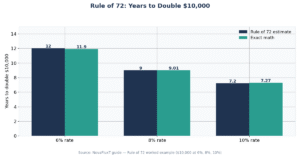
How each “exact value” was computed:
– 6%: $10,000 × 1.06^12 = $10,000 × 2.012196 = $20,121.96 — the rule overshoots a true double by 0.6%.
– 8%: $10,000 × 1.08^9 = $10,000 × 1.999005 = $19,990.05 — just $9.95 short of $20,000, an error of 0.05%.
– 10%: $10,000 × 1.10^7.2 = $10,000 × 1.986220 = $19,862.20 — 0.7% short of doubling.
Verdict: between 6% and 10% — the range most long-term investors care about — the Rule of 72 lands within about 1% of the exact answer. That is why it endures: one division, no calculator, nearly the right answer.
The math behind it
The exact doubling time for a rate r (compounded once per year) comes from solving 2 = (1 + r)^t:
t = ln(2) ÷ ln(1 + r)
Since ln(2) ≈ 0.6931, the “theoretically perfect” constant would be 69.3, not 72. So why 72? Two reasons: 72 divides evenly by 2, 3, 4, 6, 8, 9, and 12, making the mental math clean; and for the 6–10% rates investors actually encounter, 72 overcorrects slightly in exactly the way that cancels the approximation error — which is what the table above demonstrates. (Near very low rates of 2–4%, 69.3 is marginally more accurate, which is why some people quote a “Rule of 69.3” or “Rule of 70” instead.)
Frequently asked questions
Is the Rule of 72 accurate?
For typical investment returns between 6% and 10%, yes — it lands within about 1% of the exact doubling time, as the worked examples above show. At 8% it is off by just 0.05%. Accuracy degrades at extreme rates: above 20% or below 2%, use the exact formula t = ln(2) ÷ ln(1 + r), or a calculator, instead of the shortcut.
What is the Rule of 72 for 8% interest?
Divide 72 by 8 to get 9 — money growing at 8% per year doubles in about 9 years. Checked against exact compounding: $10,000 × 1.08^9 = $19,990.05, only $9.95 short of a true double, and the exact doubling time is 9.01 years. For quick planning, “9 years” is effectively the right answer.
Can I use the Rule of 72 with monthly contributions?
Not directly — the rule describes a single lump sum compounding untouched. If you add money every month, each contribution has its own doubling timeline, so the shortcut breaks down. For that scenario, use NovaFluxT’s free compound interest calculator, which handles regular monthly contributions and shows the year-by-year growth.
What is the difference between the Rule of 72, 70, and 69.3?
They are the same idea with different constants. 69.3 (= 100 × ln 2) is the mathematically exact constant for continuous compounding; 70 is a rounder compromise; 72 wins for mental math because it divides evenly by so many common rates. Between 6% and 10%, 72 is actually the most accurate of the three for once-a-year compounding.
Does the Rule of 72 account for inflation?
No — it works on whatever nominal rate you feed it. If your investment earns 8% while inflation runs 3%, your purchasing power grows at roughly 5%, so the meaningful doubling time is 72 ÷ 5 ≈ 14.4 years, not 9. Always decide whether you want the nominal answer or the inflation-adjusted (real) answer before applying the rule.
Related reading
- Compound Interest Calculator — test the rule against exact year-by-year projections for your own rate.
- Invest $500 a Month for 30 Years: How Much Will It Become? — the Rule of 72 covers lump sums; see what happens when you add money every single month.
- Retirement 401(k) Calculator — apply long-horizon compounding to your own retirement savings.