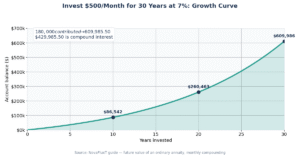
Invest $500 a month for 30 years at a 7% average annual return and you end up with $609,985.50 — built from just $180,000 of your own contributions. The other $429,985.50 is compound interest: your money earning returns, and those returns earning returns of their own.
This is the scenario almost every retirement calculator is really answering, and it deserves better than a vague “it grows a lot.” Whether you are starting your first 401(k) at 25 or catching up at 40, the mechanics are identical — only the time horizon changes what compounding can do for you. Below is the full worked calculation — the formula, every substitution, and what changes at 5% and 10% — plus a milestone view showing how growth accelerates over time. To run your own numbers instantly, use NovaFluxT’s free compound interest calculator. (One honest note: 7% is a hypothetical illustration, not a promise — real market returns vary year to year, and this is education, not financial advice.) See the SEC’s compound interest calculator. See the IRS 2026 401(k) contribution limits.
Worked example: $500/month for 30 years at 7%
We use the future value of an ordinary annuity — equal payments, invested at the end of each month, compounding monthly:
FV = P × [((1 + r)^n − 1) ÷ r]
Where P = $500 (monthly payment), r = 0.07 ÷ 12 (monthly rate), n = 30 × 12 = 360 (payments).
Step by step:
1. Monthly rate: r = 0.07 ÷ 12 = 0.0058333
2. Growth factor: (1.0058333)^360 = 8.116497
3. Subtract 1: 8.116497 − 1 = 7.116497
4. Divide by r: 7.116497 ÷ 0.0058333 = 1,219.971
5. Multiply by the payment: $500 × 1,219.971 = $609,985.50
Totals:
– Contributions: $500 × 360 = $180,000.00
– Interest earned: $609,985.50 − $180,000.00 = $429,985.50
About 70% of the final balance was earned by compounding — not contributed by you.
How growth accelerates: milestones at 7%
| After | You contributed | Balance | Interest earned |
|---|---|---|---|
| 10 years | $60,000.00 | $86,542.40 | $26,542.40 |
| 20 years | $120,000.00 | $260,463.33 | $140,463.33 |
| 30 years | $180,000.00 | $609,985.50 | $429,985.50 |
The last 10 years alone add $349,522.17 — more than the entire first 20 years combined ($260,463.33). That is compounding working on an ever-larger base: the longer you stay invested, the harder each year works.
Same habit, different returns
| Annual return | Final balance | Interest earned |
|---|---|---|
| 5% | $416,129.32 | $236,129.32 |
| 7% | $609,985.50 | $429,985.50 |
| 10% | $1,130,243.96 | $950,243.96 |
A 3-percentage-point difference in average return nearly doubles the outcome — which is why fund fees and asset choice matter enormously over decades.
The math behind it
The annuity formula assumes end-of-month payments compounding monthly at a fixed rate — a simplification of real markets, but the standard way to illustrate long-horizon growth. Each variable: P = payment per period ($500), r = periodic interest rate (0.07 ÷ 12), n = total number of periods (360). If payments were made at the start of each month instead of the end, every figure would be slightly higher (one extra month of compounding per payment) — the difference is small next to the rate effect shown above.
Frequently asked questions
Is investing $500 a month enough to retire on?
It depends on your timeline, spending, and other savings — but $609,985.50 from 30 years at 7% is a serious foundation. Many retirees combine investment accounts with Social Security and employer plans. The honest answer: $500/month is an excellent habit that puts you far ahead of saving nothing, but run your own target through a retirement calculator rather than trusting any single number.
What if I only have 20 years instead of 30?
At 7%, $500/month for 20 years (240 payments) grows to $260,463.33 from $120,000 contributed — the interest earned is $140,463.33. You lose more than half the 30-year result by cutting the last decade, which is exactly when compounding does its heaviest work. Starting earlier beats saving more, almost every time.
Is the 7% annual return guaranteed?
No. The 7% figure is a hypothetical illustration commonly used for long-term stock market planning — actual returns swing year to year and can be negative for stretches. No investment guarantees 7%. Treat every number in this guide as a “what-if” scenario for planning, not a prediction, and never invest money you cannot afford to leave alone for years.
Should I invest monthly or save up a lump sum?
If you have a lump sum available, investing it sooner generally wins because of time in the market. But most people do not — and a steady $500/month habit that you actually maintain beats a perfect lump-sum plan you never execute. Automating the monthly investment removes the decision entirely, which is where most plans fail.
Do taxes change these numbers?
Yes — the figures above are pre-tax. In a 401(k) or traditional IRA, growth is tax-deferred (you pay income tax on withdrawals); in a Roth account, qualified withdrawals are tax-free; in a regular taxable account, you owe tax on dividends and gains along the way. The account type can change your spendable result significantly, so pick it deliberately.
Related reading
- Compound Interest Calculator — run this exact scenario with your own monthly amount and rate.
- Rule of 72: How Long to Double Money (With Real Examples) — the quick mental shortcut behind the compounding in this guide, verified against exact math.
- Retirement 401(k) Calculator — see how monthly investing translates into retirement income.