How much does take home pay in California vs Texas actually differ? On a $100,000 salary, a single filer keeps about $73,972 in California versus $79,180 in Texas — a $5,208-per-year gap driven entirely by California’s state income tax. Run your own salary through NovaFluxT’s free income tax estimator and the salary paycheck calculator, then use this guide to see exactly where the difference comes from.
Federal tax and FICA are identical in both states — the IRS doesn’t care where you live. The entire gap is California’s progressive state income tax (1% to 9.3% on this income) versus Texas’s 0%. But the honest picture is wider than income tax: housing costs and property taxes can dwarf the $434/month tax gap, as we’ll show.
All figures below are computed from the actual 2026 IRS brackets and the Franchise Tax Board’s published 2026 California brackets — real math, no estimates or guesswork at all. See the IRS’s official 2026 inflation adjustments. The SSA publishes the current FICA tax rates.
Worked example: $100,000 salary, single filer, 2026
Assumptions (labeled): single filing status, 2026 federal standard deduction ($16,100), 2026 California standard deduction ($5,706) and 2026 CA brackets (FTB), no pre-tax deductions, no local taxes.
Federal tax + FICA (same in both states)
- Taxable income: $100,000 − $16,100 = $83,900
- Federal: 10% × $12,400 = $1,240; 12% × $38,000 = $4,560; 22% × $33,500 = $7,370 → $13,170
- FICA: Social Security $100,000 × 6.2% = $6,200; Medicare $100,000 × 1.45% = $1,450 → $7,650
- Combined federal burden: $20,820
California state tax
CA taxable income: $100,000 − $5,706 = $94,294. Applying the 2026 CA brackets slice by slice:
| Bracket | Slice taxed | Tax |
|---|---|---|
| 1% on first $11,079 | $11,079 | $110.79 |
| 2% on $11,080–$26,264 | $15,185 | $303.70 |
| 4% on $26,265–$41,452 | $15,188 | $607.52 |
| 6% on $41,453–$57,542 | $16,090 | $965.40 |
| 8% on $57,543–$72,724 | $15,182 | $1,214.56 |
| 9.3% on $72,725–$94,294 | $21,570 | $2,006.01 |
| Total CA tax | $5,207.98 ≈ $5,208 |
The side-by-side result
| California | Texas | |
|---|---|---|
| Gross salary | $100,000 | $100,000 |
| Federal income tax | −$13,170 | −$13,170 |
| FICA | −$7,650 | −$7,650 |
| State income tax | −$5,208 | $0 |
| Take-home pay | $73,972 | $79,180 |
| Monthly | $6,164 | $6,598 |
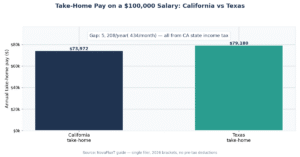
The gap: $5,208/year, or about $434/month — real money, but context matters (below).
Two honest caveats
1. California also takes SDI. On top of the $5,208, California withholds State Disability Insurance — roughly $1,200/year on a $100,000 salary at the 2025 rate of 1.2% (the 2026 rate was not yet confirmed at writing). Texas has no equivalent. That pushes the true gap toward ~$6,400/year.
2. Income tax isn’t the whole cost-of-living story. Texas offsets zero income tax with some of the nation’s highest property taxes (~1.6–1.8% effective rates are typical, vs ~0.75% in California under Prop 13 — approximate, varies by county). And housing dwarfs everything: a $1,500/month rent difference is $18,000/year — triple the income-tax gap. Never decide a move on income tax alone.
Frequently asked questions
Does Texas really have no state income tax?
Correct — Texas is one of nine states with no tax on wage income, and its constitution makes enacting one extremely difficult. You still pay full federal income tax and FICA in Texas. The state funds itself largely through sales tax (6.25% state + up to 2% local) and property taxes, which are among the highest in the country.
What is California SDI and how much does it cost?
State Disability Insurance is a California payroll tax funding paid family leave and disability benefits. It’s withheld from wages up to an annual cap — about $1,200/year on a $100,000 salary at the 2025 rate of 1.2%. Most workers never think about it until they see the “CA SDI” line on their pay stub, but it’s a real part of the California-Texas gap.
If I work remotely for a California company from Texas, which tax do I pay?
Generally, you pay tax where you physically work — a Texas resident working remotely for a California employer typically owes no California income tax on those wages. But California is aggressive about sourcing rules for nonresidents, and hybrid schedules get complicated fast. This is general information, not tax advice — confirm with a professional.
Which state leaves me richer overall, California or Texas?
On income tax alone, Texas wins by ~$5,200/year at $100,000. But “richer overall” depends on housing, property tax, insurance, and childcare costs in your specific cities. A common honest answer: Texas wins for most middle-income households, while high earners in California’s major metros can still come out ahead on career earnings despite the tax.
Where can I compare take-home pay for my own salary and state?
Run your numbers in NovaFluxT’s free income tax estimator for the federal side, then layer on your state’s brackets — or use the salary paycheck calculator for the full paycheck picture. Enter your salary, filing status, and state to see federal, FICA, and state tax side by side in seconds, no sign-up needed.
Related tools and guides
- Income Tax Estimator — federal tax on any salary
- Salary Paycheck Calculator — full paycheck breakdown
- 2026 Federal Tax Brackets Explained — where the $13,170 comes from
- How Much Tax on a $100,000 Salary in 2026? — the federal-only version
- $25 an Hour After Taxes — the same math at a lower wage