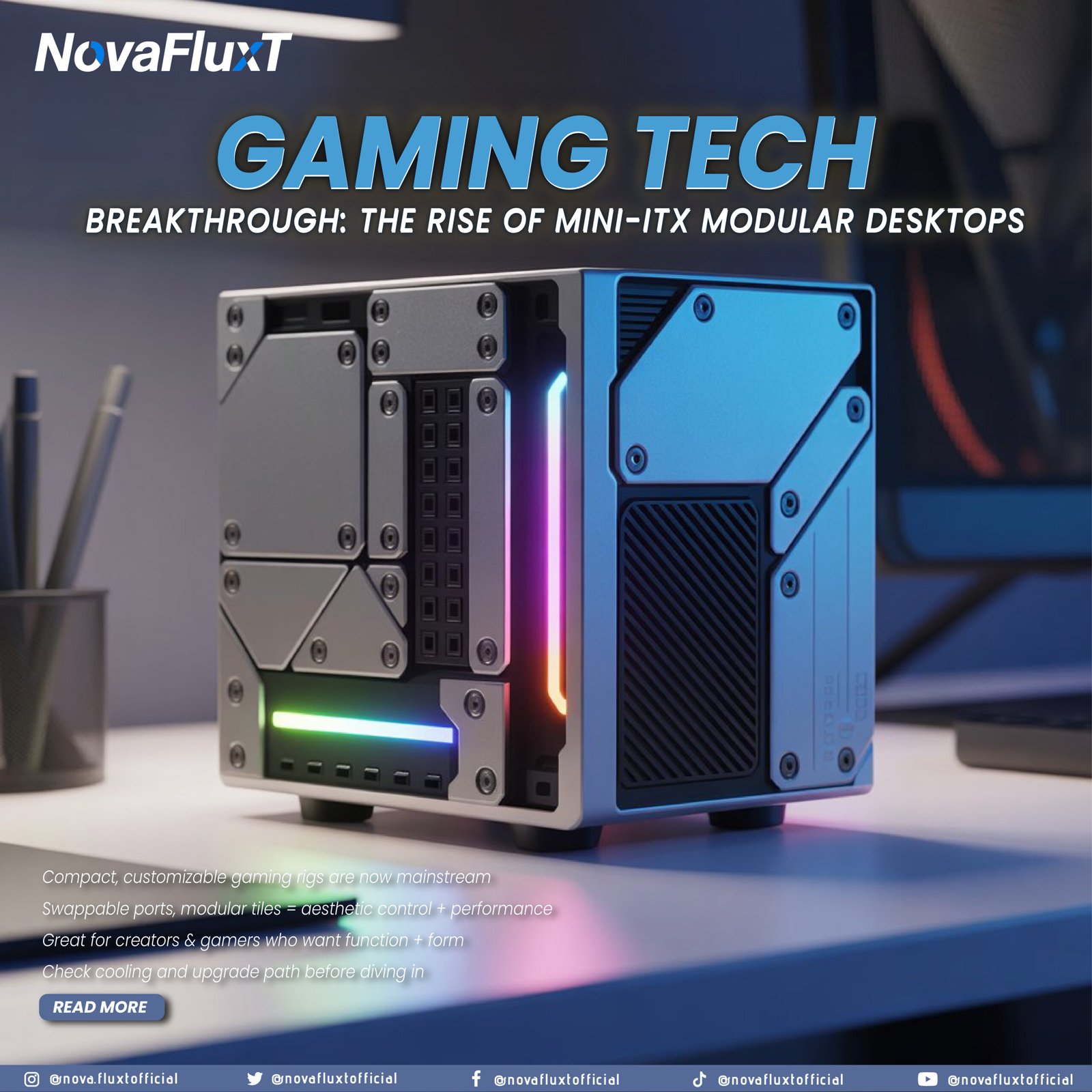
The desktop PC world is undergoing a transformative shift. Gone are the days when high‑end gaming or creator rigs had to occupy cavernous mid‑ or full‑towers. Enter the Mini‑ITX modular desktop: compact, powerful, customizable. This isn’t just about size — it’s about mobility, style, performance and modularity. In this article, we explore why this trend is accelerating, what modular really means, who the target users are, and critical considerations for a successful build in 2025.
Market Momentum
Recent market intelligence shows significant tailwinds: the Mini‑ITX desktop market size reached approximately USD 2.1 billion in 2024 with a projected ~7.2% CAGR from 2025 to 2033.On the chassis front, Mini‑ITX case market growth is similarly strong, driven by gamers and creators. This indicates that builders and buyers are shifting toward compact performance platforms.
1. Compact, Customizable Gaming Rigs Are Now Mainstream
What was once a niche for enthusiasts is now reaching wider adoption. Mini‑ITX systems now support full‑sized GPUs, high‑end CPUs, advanced cooling and modular I/O — all while taking up minimal desk real estate. Case example: the Cooler Master NR200P V3 (Mini‑ITX) that supports GPUs as large as an RTX 5090.
This “small but mighty” form factor meets modern demands for dual‑purpose machines (gaming + work + media) in tight spaces and stylish setups.
2. Swappable Ports, Modular Tiles = Aesthetic + Performance
Modularity is more than marketing. The Framework Desktop (Mini‑ITX) offers swappable front‑I/O cards and customizable panels/tiles, enabling both functional changes (ports) and aesthetic personalization.
For builders and brands, this means:
- Upgrade ports/IO without replacing the entire system.
- Maintain full‑size performance components in a compact shell.
- Deliver turn‑key high‑spec rigs that still allow personalisation and future‑proofing.
3. Great for Creators & Gamers Who Want Function + Form
Creators filming, gamers streaming, and professionals working from hybrid setups increasingly want rigs that look good on camera, fit into stylish setups, and deliver power. Mini‑ITX systems check boxes:
- Dual‑purpose: gaming and content creation workflows.
- Portable: easier to carry to LAN events, streaming setups.
- Aesthetic: visually appealing builds with minimal footprint.
Here’s the catch: you still want high performance — so cooling, airflow, upgrade path matter.
4. Check Cooling and Upgrade Path Before Diving In
Mini‑ITX brings constraints: less internal volume, tighter cable routing, potential thermal issues. According to market reports, one barrier to adoption remains thermal management and upgrade difficulty.
Checklist for builders:
- GPU length and thickness clearance (especially for high‑end cards).
- Sufficient airflow, radiator/fan placement in compact cases.
- Power supply form‑factor (SFX vs standard) and future PSU upgrades.
- Expandability: storage configurations, RAM, cooling upgrades.
- Warranty/support for modular I/O parts.
Benefits & Limitations
Benefits:
- High performance in small footprint.
- Stylish, discreet setups (ideal for creator‑studio, streaming).
- Easier transport/mobility for LANs or dual‑purpose use.
Limitations:
- Premium cost for compact high‑spec parts.
- Thermal/cooling considerations require design care.
- Upgradability may be more limited than larger towers.
- Cable management and installation complexity higher.
Mini‑ITX modular desktops represent a pivotal shift: high‑end power in small, stylish, configurable packages. For gamers, creators and system integrators, the message is clear: you no longer have to choose between performance and footprint. But success requires smart component selection, cooling planning and understanding trade‑offs.
🖥️ NovaFluxT — Build tiny. Play mighty